
SMART goals are a key feature in your WorkCompass progress plan.
For many organisations, less than 3% of all goals that are set are SMART. Like projects, it can be difficult to fully understand the end result of a goal, and all of the steps to get there if there is a lack of clarity. Your goals are just as important.
Without this clarity, friction can develop between the Employee and their Manager.
So, what does SMART mean? Generally, SMART stands for:
- Specific
- Measurable
- Actionable
- Relevant
- Time-bound
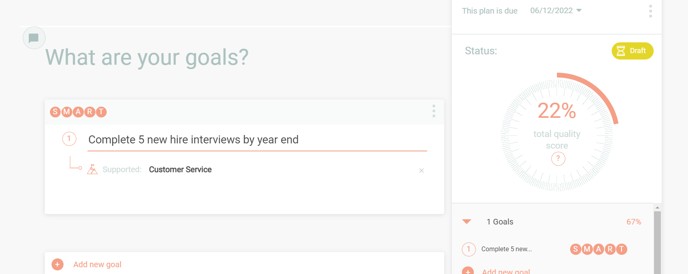
WorkCompass will help you to set SMART goals using an artificial intelligence tool. The tool will pop up to guide you through the process. It will read what you write and make suggestions around how to make your goals smarter. If all the letters are lit up, then it means you created a SMART goal.
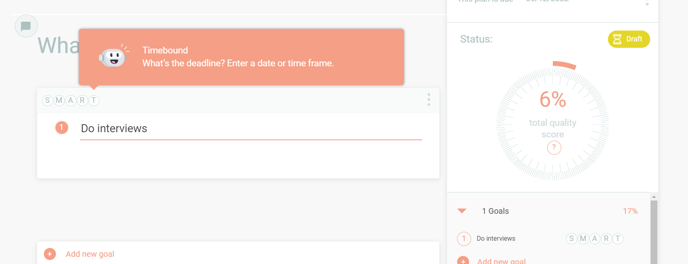
Below is an example of a goal that doesn't meet any of the SMART criteria VS a goal that meets all of the SMART criteria:
A goal that does not meet any SMART criteria
A goal that meets all of the SMART criteria
Note: It is not required specifically to create your goals a SMART goals.
There will be times where perhaps your goal isn’t relevant to a larger organisational goal or perhaps it will be an open goal that you will have every year. We acknowledge that that is the case.
In these instances, you will be able to proceed without highlighting all 5 letters.
This is not a “tick the box” exercise. It is a tool to help you create goals that are as valuable as possible.